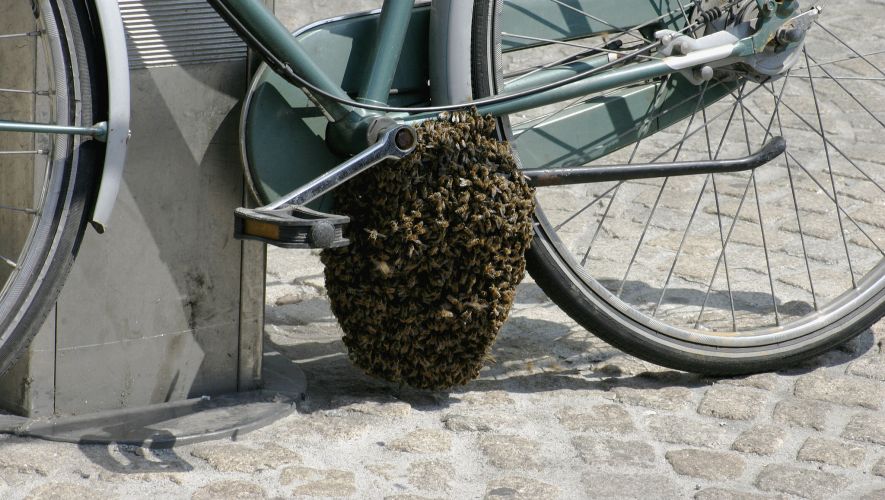
So, swarms are getting lots of air time at the moment here in the UK. Recent news stories blame the ‘latest middle-class fad’ of amateur urban beekeeping for the rise of swarms to be found in our town centres. And here at Suburban Bee Company this week, Pauline, our resident swarm capture expert, has been out collecting a swarm that appeared in a garden at the end of our street. This time luckily, the little escape artists weren’t from one of our hives, so we acquired a new colony and a relieved neighbour.
A few words then on honey bees and swarming. This is something that all beekeepers will experience at some point and even if we assume most of the media coverage is tending towards hyperbole, there is aways a chance that you may find a swarm in your garden or hanging from the lamp post or shop sign as you stroll down the road.
First things first; the why, what and when of swarms. A swarm is the mechanism used by honey bees to reproduce the colony in the wild. This provides the ability to grow the number of colonies sharing the same genetic material and gives the bees a chance to move to a new, clean and hopefully disease free home. The swarm itself usually consists of the queen and a large proportion of the flying bees of the hive. The non-flying housekeeping bees are left behind with one or more queens in the making. Queens are raised from egg to emerging adult in a special queen cell that hangs from the comb. The old queen is slimmed down by the workers before swarming to allow her to fly. The bees will leave the hive once the new queen is sealed into the queen cell to mature from lava to adult. That happens roughly 8 days after the egg is laid that will soon become the new queen. Actually, that’s why beekeepers will usually check their hives on a weekly basis, making sure there aren’t any queen cells brewing. Here in the south of the UK, we need to carefully check hives from April through to the end of July as bees can swarm at any point in that time.
If you don’t keep bees but spot a swarm, here’s a well kept secret for you. Bees clustered in a swarm are actually calm and don’t pose too much of a threat as long as you don’t poke them. Swarming bees are carrying the honey they need to begin a new colony, make wax and keep themselves alive for a few days. As a result, they tend not to pick fights. You can check on the internet for your local swarm collection officer or a beekeeper who can be contacted to come and collect your bees. We beekeepers are always happy to collect a swarm as this is very good way to gain new colonies. Although it’s always best to check for disease before putting them close to any existing hives.
As beekeepers, we are really trying to prevent swarming – although that can be an uphill task. In a bee hive, swarming can be triggered by overcrowding or an ageing queen (both are linked to the amount of queen pheromone that the worker bees can detect). Prevention therefore consists of ensuring your bees have enough room by adding honey supers when needed and making sure that the hive has a young and vigorous queen by re-queening every couple of seasons. Some bee populations are more likely to swarm than others, so selecting a queen that comes from less ‘swarmy’ stock is always a good idea.
However hard we try, prevention only goes some of the way to stopping that cloud of bees departing the hive. Once the bees have started creating queen cells and getting as a far as encouraging the queen to lay eggs in them, we have to move from prevention to control. Before the queen cell is sealed and the bees fly, we can encourage the bees to think they have swarmed – this is called artificial swarming. There are many ways to perform this procedure so it’s a good idea to learn one you feel comfortable with for those stressful days when you find that queen cell during an inspection. The outcome from an artificial swarm is usually to have two hives where there used to be one. The old queen and flying bees may be left in one of the hives with housekeeping bees, brood and a good queen cell in the other hive. Beekeepers decide if they want to keep 2 hives or if, later in the year, they will recombine the bees from both hives to return to a single colony. Whatever your preferred method, hopefully that’s the crisis over.
And a final word of advice to anyone thinking of keeping bees, whether for scientific interest, harvesting delicious local honey or to help our environment. Bees are wild animals rather than domesticated animals like cows or goats. They can’t be trained and we find they almost certainly behave unpredictably from time to time. As a beekeeper our primary responsibility is to keep our bees healthy and prevent swarming as far as possible. Definitely join a local beekeeping association where you will find plenty of experienced keepers to help you. Here in the UK, the British Beekeepers Association also has a range of examinations and the Basic Beekeeper Assessment is fantastic proof of your competence about looking after bees.
Bees are fabulously interesting and this short article has barely touched their complex world. There are dozens of great books and thousands of web articles on the topic of swarming and the bee lifecycle so if you’re in any way interested please do take a look. It may well be that the newspapers and TV are really not doing us justice.
 Suburban Bee Company